Working Group 2
What is the impact of the GIBA on ageing and neurodegeneration?
Exploring how interactions between the gut, the immune system and the brain are involved in the development of neurodegeneration in the context of ageing.
We are a diverse group of researchers interested in questions such as: How does ageing influence our gut, immune system and brain? Do changes in the microbiota and gut physiology contribute to the development of dementias? Can we modify gut-immune-brain interactions to delay or prevent the onset of neurodegenerative conditions such as Alzheimer’s and Parkinson’s disease? What model systems can we exploit to investigate these questions and how can we translate findings from in vitro and animal studies to humans? We meet monthly to share and discuss our research, and to develop resources for both academics and the public.

Working Group Leads

Aimee Parker
Early Career Research Lead at GIBA Network+
Following a PhD in Immunology at the University of Cambridge, Aimee helped to develop interdisciplinary approaches to intestinal stem behaviour in health and disease at the Institute of Food Research. As a Senior Research Scientist at the Quadram Institute, Aimee’s work has determined a key role for the gut microbiota in regulating age-associated inflammation. Her current research as a BBSRC Fellow at the Quadram Institute explores how the microbiota can be modulated to protect the ageing eye and brain.

Simon McArthur
Senior Lecturer in Neuroscience & Pharmacology Clinical at Queen Mary University of London
Simon read Natural Sciences (Pharmacology) at the University of Cambridge, followed by a PhD in Neuropharmacology at Imperial College London in 2004. His thesis and postdoctoral work with Professor Glenda Gillies and Dr Egle Solito at Imperial College London examined the influence of peripheral stress and inflammation upon neuroinflammatory pathology in conditions including Parkinson’s disease, multiple sclerosis and Alzheimer’s disease.
In 2011, he moved to Queen Mary, University of London and undertook postdoctoral research with Professors Rod Flower and Mauro Perretti at the William Harvey Research Institute, studying mechanisms of inflammatory resolution and the roles of monocytes/macrophages in the termination of acute inflammation.
In 2014, he was appointed as a Lecturer in Physiology at the University of Westminster, where he first developed his interest in the gut–brain axis and the mechanisms linking the gut microbiota with brain pathology in neurodegenerative disease, in collaboration with Dr Lesley Hoyles. In 2016, he took up his current position as a non-clinical Senior Lecturer in Neuroscience & Pharmacology at the Institute of Dentistry, QMUL, where he continues his research investigating the gut–brain axis and its relevance to neurodegenerative disease.
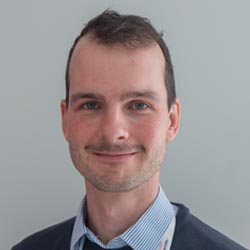
James Conway
Research Fellow at the UK DRI at UCL
James is a Research Fellow in the Bartels lab at the UK Dementia Research Institute at UCL, working on gut–brain axis spreading of alpha-synuclein. He is a co-lead of the UK GIBA network’s working group on ageing and neurodegeneration, and he also runs a PPI group in collaboration with Parkinson’s UK.
He completed his PhD in 2024 in the Kramer lab at the University of Plymouth’s Derriford Research Facility. His research focused on the role of the E3 ubiquitin protein ligases NEDD4-1 and NEDD4-2 in the mouse dopaminergic midbrain and their crosstalk with alpha-synuclein. He was also the Alzheimer’s Research UK early career research representative for the University of Plymouth.